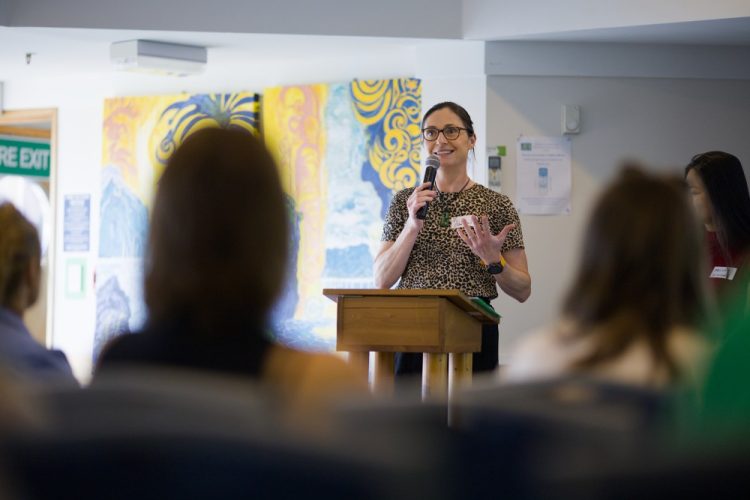
Fiona Deehan

February 2nd, 2026

Held, Challenged, Changed: A Leadership Lab Journey

Leadership Lab has been part of my life for over six years. The people, the kaupapa, and the ways of working and being have given me the grounding and resolve to act, to be the leader I want to be, to have a positive impact on the world, and to be part of a movement that changes systems and creates equitable and thriving communities.

When I first came across Leadership Lab in 2018 it was at one of their public Activator events. I listened to speakers share insights into diverse and inclusive teams. I honestly didn’t really know what that meant at the time, but something felt right in what I heard.

In 2019, I joined LinC Cultivator, a community leadership programme centred on leaders coming together to connect and learn from each other. It was here that I experienced a couple of moments that fundamentally reshaped my understanding of Aotearoa’s colonial and heartbreaking history, and where I began to see similarities (though not sameness — as the experiences are very different) with my homeland, Ireland.

At one hui, I remember watching something unfold that I didn’t fully understand, while also feeling deeply uncomfortable. One of the facilitators, a Māori wahine, sat sharing her story of growing up disconnected from her culture. It was a lot — for her to share, for us to hold — but it mattered. As she spoke, a young white woman moved closer to her, first placing an arm around her as if in comfort. Then she sat beside her, and bit by bit, created space for herself on the single chair until she had taken it completely.  As I felt powerful feelings of indignation and anger I only then realised that this was an intended scenario to illustrate a point. That moment became a deeply uncomfortable learning experience, one that profoundly shaped my understanding of inequity and colonisation in Aotearoa.

Another moment that connected me to my homeland’s history came during a timeline activity at a different hui. As we discussed 1840 and what was happening here, the question was asked: “Where were your people, your tīpuna, when this was happening?” My first thought was: I don’t know exactly, but I do know that at this time Irish people were starving in a famine — a famine created by a colonial system that allowed them to starve.

These moments were foundational. They shaped my understanding of the weight and impact of colonialism, the intergenerational trauma that followed, and the realisation that I didn’t know or understand enough about what it meant to be Irish, even though I had spent the first 28 years of my life there.

Since then, my haerenga (journey) with Leadership Lab has evolved from being a team member on Cultivator to evaluating and facilitating programmes, strengths coaching, social media management, website redesign and rebuild, podcasting, and impact storytelling. I’ve loved impact storytelling because, to me, it’s the “so what” — where we begin to see the sparks of change and the hope that our actions, even the small ones, make a difference.

Here are two I’d like to share:

Impact story#1 Wiremu – Cultural Supervisor, NZAC Counsellors

As a cultural supervisor for NZAC-registered counsellors, I have repeatedly heard feedback about the depth of impact the Becoming Tangata Tiriti podcast, facilitated by Fiona and Gwyn, has had on practitioners. Counsellors describe the podcast as a catalyst for meaningful self-reflection, particularly around power, privilege, identity, and their responsibilities as Tangata Tiriti working within Te Tiriti o Waitangi commitments. What stands out consistently is how transformative it has been to hear these conversations led by Tangata Tiriti voices. For many counsellors, this created a sense of safety and openness that allowed them to listen more intentionally, confront previously unexamined beliefs, and shift long-held narratives. These reflections have influenced not only their personal worldviews but also strengthened their cultural responsiveness, ethical practice, and commitment to ongoing learning in their counselling mahi.

Impact story#2: Piripi – Māori facilitator and consultant

Fi, I’m genuinely saddened that you are leaving…a huge mihi to you for standing up, for advocating, and for supporting te reo Māori and the Māori worldview. As you know, it has been a very tough few months politically for anything kaupapa Māori, and personally it has stung. So when I have the absolute pleasure of working with tūmeke individuals like yourself, it makes the heart sing. Nui te mihi me te aroha e Fi. Hopefully our paths cross again — and if they don’t, know that I will never forget what you did for me personally and for this beautiful culture, te reo Māori me ōna tikanga.

I share these stories not as praise for myself, but as an acknowledgement of the space that Leadership Lab created — a space that enabled me to step forward and take action in ways I previously wouldn’t have.

The first story relates to the Becoming Tangata Tiriti podcast series – a collaboration with my Leadership Lab colleague Gwyn John where in 2023 we recorded an extended conversation about our understanding of Aotearoa history and considered our role as Tangata Tiriti. The second relates to a number of separate actions: in my first week in a new role and organisation, I stood alongside Piripi at a Matariki presentation and introduced myself with my pepeha to the whole office; I learned the company waiata on the guitar and began organising practice sessions; I prioritised the rollout of a te reo and tikanga course and secured budget for further learning the following year.

I simply would not have had the confidence or the backbone to do these things without the support, learning, and connection I experienced through my years with Leadership Lab.

Separately from these stories, things came full circle with the “chair incident” when that same wahine — now a friend — asked me, five years later, to be the one to nudge her off the chair in a similar exercise. This time, I knew exactly what I was doing. I felt sick to my stomach, but I did it because she trusted me, and she needed me to push past my discomfort to help her make the point. So I did.

After almost 16 years in Aotearoa, my husband and I are taking our kids “home” to Ireland so they can more meaningfully connect with their whānau and whenua. Aotearoa is also home — just in a different way. Leadership Lab has been part of this decision too. All of the experiences I’ve shared are woven into who I am now, and I will take them with me in my heart, along with my Leadership Lab whānau.

Thank you. Go raibh míle maith agaibh go léir.

Ehara taku toa i te toa takitahi, he toa takitini.
Our strength is not as individuals, but as a collective.

Ar scáth a chéile a mhaireann na daoine.
“In the shelter of each other, the people live.”
Scáth also means “shadow,” so it can be read as “In each other’s shadow, we live.” This sean fhocal speaks to our interconnectedness and our shared humanity.

This piece was written by Fi Deehan.

Fiona Deehan

February 2nd, 2026

Held, Challenged, Changed: A Leadership Lab Journey

Leadership Lab has been part of my life for over six years. The people, the kaupapa, and the ways of working and being have given me the grounding and resolve to act, to be the leader I want to be, to have a positive impact on the world, and to be part of a movement that changes systems and creates equitable and thriving communities.

When I first came across Leadership Lab in 2018 it was at one of their public Activator events. I listened to speakers share insights into diverse and inclusive teams. I honestly didn’t really know what that meant at the time, but something felt right in what I heard.

In 2019, I joined LinC Cultivator, a community leadership programme centred on leaders coming together to connect and learn from each other. It was here that I experienced a couple of moments that fundamentally reshaped my understanding of Aotearoa’s colonial and heartbreaking history, and where I began to see similarities (though not sameness — as the experiences are very different) with my homeland, Ireland.

At one hui, I remember watching something unfold that I didn’t fully understand, while also feeling deeply uncomfortable. One of the facilitators, a Māori wahine, sat sharing her story of growing up disconnected from her culture. It was a lot — for her to share, for us to hold — but it mattered. As she spoke, a young white woman moved closer to her, first placing an arm around her as if in comfort. Then she sat beside her, and bit by bit, created space for herself on the single chair until she had taken it completely.  As I felt powerful feelings of indignation and anger I only then realised that this was an intended scenario to illustrate a point. That moment became a deeply uncomfortable learning experience, one that profoundly shaped my understanding of inequity and colonisation in Aotearoa.

Another moment that connected me to my homeland’s history came during a timeline activity at a different hui. As we discussed 1840 and what was happening here, the question was asked: “Where were your people, your tīpuna, when this was happening?” My first thought was: I don’t know exactly, but I do know that at this time Irish people were starving in a famine — a famine created by a colonial system that allowed them to starve.

These moments were foundational. They shaped my understanding of the weight and impact of colonialism, the intergenerational trauma that followed, and the realisation that I didn’t know or understand enough about what it meant to be Irish, even though I had spent the first 28 years of my life there.

Since then, my haerenga (journey) with Leadership Lab has evolved from being a team member on Cultivator to evaluating and facilitating programmes, strengths coaching, social media management, website redesign and rebuild, podcasting, and impact storytelling. I’ve loved impact storytelling because, to me, it’s the “so what” — where we begin to see the sparks of change and the hope that our actions, even the small ones, make a difference.

Here are two I’d like to share:

Impact story#1 Wiremu – Cultural Supervisor, NZAC Counsellors

As a cultural supervisor for NZAC-registered counsellors, I have repeatedly heard feedback about the depth of impact the Becoming Tangata Tiriti podcast, facilitated by Fiona and Gwyn, has had on practitioners. Counsellors describe the podcast as a catalyst for meaningful self-reflection, particularly around power, privilege, identity, and their responsibilities as Tangata Tiriti working within Te Tiriti o Waitangi commitments. What stands out consistently is how transformative it has been to hear these conversations led by Tangata Tiriti voices. For many counsellors, this created a sense of safety and openness that allowed them to listen more intentionally, confront previously unexamined beliefs, and shift long-held narratives. These reflections have influenced not only their personal worldviews but also strengthened their cultural responsiveness, ethical practice, and commitment to ongoing learning in their counselling mahi.

Impact story#2: Piripi – Māori facilitator and consultant

Fi, I’m genuinely saddened that you are leaving…a huge mihi to you for standing up, for advocating, and for supporting te reo Māori and the Māori worldview. As you know, it has been a very tough few months politically for anything kaupapa Māori, and personally it has stung. So when I have the absolute pleasure of working with tūmeke individuals like yourself, it makes the heart sing. Nui te mihi me te aroha e Fi. Hopefully our paths cross again — and if they don’t, know that I will never forget what you did for me personally and for this beautiful culture, te reo Māori me ōna tikanga.

I share these stories not as praise for myself, but as an acknowledgement of the space that Leadership Lab created — a space that enabled me to step forward and take action in ways I previously wouldn’t have.

The first story relates to the Becoming Tangata Tiriti podcast series – a collaboration with my Leadership Lab colleague Gwyn John where in 2023 we recorded an extended conversation about our understanding of Aotearoa history and considered our role as Tangata Tiriti. The second relates to a number of separate actions: in my first week in a new role and organisation, I stood alongside Piripi at a Matariki presentation and introduced myself with my pepeha to the whole office; I learned the company waiata on the guitar and began organising practice sessions; I prioritised the rollout of a te reo and tikanga course and secured budget for further learning the following year.

I simply would not have had the confidence or the backbone to do these things without the support, learning, and connection I experienced through my years with Leadership Lab.

Separately from these stories, things came full circle with the “chair incident” when that same wahine — now a friend — asked me, five years later, to be the one to nudge her off the chair in a similar exercise. This time, I knew exactly what I was doing. I felt sick to my stomach, but I did it because she trusted me, and she needed me to push past my discomfort to help her make the point. So I did.

After almost 16 years in Aotearoa, my husband and I are taking our kids “home” to Ireland so they can more meaningfully connect with their whānau and whenua. Aotearoa is also home — just in a different way. Leadership Lab has been part of this decision too. All of the experiences I’ve shared are woven into who I am now, and I will take them with me in my heart, along with my Leadership Lab whānau.

Thank you. Go raibh míle maith agaibh go léir.

Ehara taku toa i te toa takitahi, he toa takitini.
Our strength is not as individuals, but as a collective.

Ar scáth a chéile a mhaireann na daoine.
“In the shelter of each other, the people live.”
Scáth also means “shadow,” so it can be read as “In each other’s shadow, we live.” This sean fhocal speaks to our interconnectedness and our shared humanity.

This piece was written by Fi Deehan.